
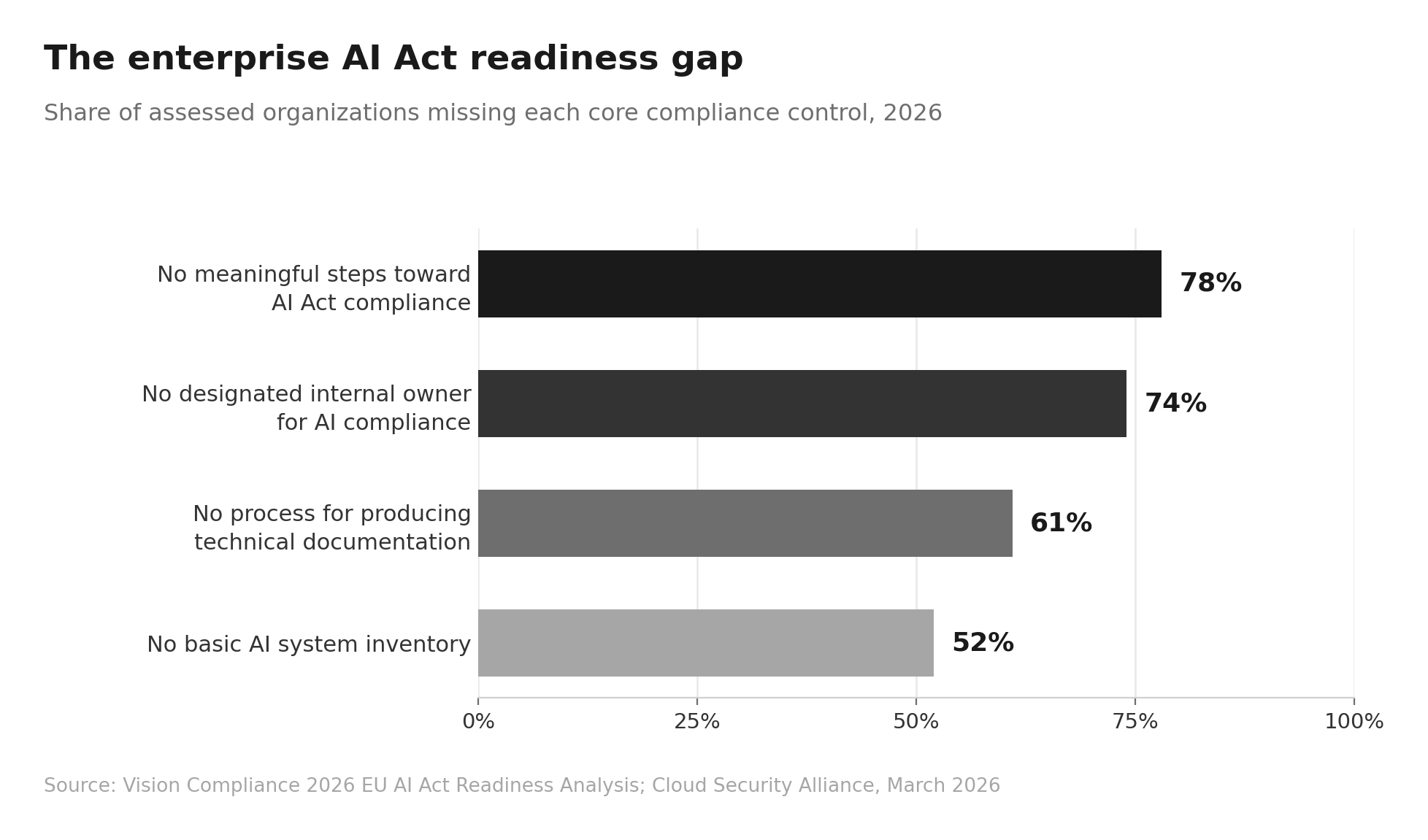
A 2026 assessment across eight industries found 78% of organizations had taken no meaningful steps toward AI Act compliance, and 74% had no designated internal owner for it (source: Vision Compliance).
Growth Centr tracks the regulatory shifts that decide whether teams can keep shipping, and AI regulation is now the largest constraint on enterprise AI deployment in Europe.
On 2 August 2026 the AI Act crossed into live enforcement, while the Digital Omnibus on AI pushed the heaviest obligations to late 2027.
Those two facts are frequently confused, and confusing them is expensive.
This guide breaks down what changed, which protection requirements apply now, what compliance costs, and what to do next.
Key Takeaways
- Article 50 transparency and the full penalty regime applied from 2 August 2026.
- High-risk obligations moved to 2 December 2027 under Regulation (EU) 2026/1744.
- Maximum fines reach €35 million or 7% of global annual turnover.
- Recurring compliance runs roughly €29,277 per high-risk AI system, per year.
- AI risk classification decides every obligation; without an inventory, nothing else moves.
- Deployers who modify a vendor system legally become the provider.
What "AI Protection" Means Under the EU AI Act
AI protection is not one control. Under Regulation (EU) 2024/1689 it is a stack of ten obligations that decide whether a system is lawful to operate in Europe.
Treat AI protection as a security question alone and you fail on documentation.
Treat it as paperwork, and you fail on robustness.
The ten pillars of AI protection the Act actually enforces:
- AI system inventory and use-case mapping, the gate every other duty sits behind
- Risk classification into prohibited, high-risk, limited-risk, or minimal-risk tiers
- AI risk management system, continuous and documented across the lifecycle
- Data governance, covering representativeness, bias examination, and provenance
- Technical documentation assembled before market entry and kept current
- Human oversight designed in, with genuine override and stop capability
- AI model security, including resistance to data poisoning and model extraction
- Adversarial robustness against evasion attacks and prompt-level manipulation
- Post-market monitoring with automatic logging retained for at least six months
- AI incident reporting to the correct authority inside the correct window
A conformity assessment proves those ten hold together for a high-risk system. An AI governance framework is what keeps them holding after the assessment is signed.
The Regulatory Baseline: Where the AI Act Actually Stands
The EU AI Act, Regulation (EU) 2024/1689, entered into force on 1 August 2024 as the first comprehensive horizontal AI law anywhere.
Article 113 stages it, and four phases had landed by August 2026: prohibited practices and the AI literacy duty from 2 February 2025, general-purpose AI (GPAI) obligations from 2 August 2025, and on 2 August 2026 the AI transparency obligations under Article 50 plus the enforcement machinery.
The high-risk regime did not arrive on schedule.
By late 2025 the harmonised standards that would have given high-risk AI systems a presumption of conformity were not ready, and national authorities had not been uniformly designated.
The Commission tabled the Digital Omnibus on AI on 19 November 2025 to fix the timing without reopening the substance, and that fix is now law.
Parliament approved it on 16 June 2026 by 423 votes to 57, the Council adopted it on 29 June 2026, and Regulation (EU) 2026/1744 was published in the Official Journal on 24 July 2026, entering into force on 27 July 2026 (source: Cloud Security Alliance). It cleared the original deadline by six days.
Why Enterprise Exposure Outgrew Enterprise Governance
The regulation is landing in a market that adopted AI faster than it built controls.
In 2025, 20.0% of EU enterprises with 10 or more employees used AI technologies, up 6.5 percentage points from 13.5% in 2024, the sharpest single-year jump since measurement began (source: Eurostat). Adoption is uneven: Denmark sits at 42.0%, Romania at 5.2%.
Governance did not keep pace. A March 2026 research note found more than half of organizations still lacked a basic AI system inventory (source: Cloud Security Alliance).
Without one, AI risk classification is impossible, and classification gates every other obligation.
The same analysis found 61% had no process for producing the required technical documentation, and flagged conformity assessment and post-market monitoring as new territory for most compliance teams.
Procurement makes it worse. AI arrives embedded in tools bought as CRM, ATS, or support software, which is why shadow AI is a compliance problem, not just a security one.
Start with an AI governance framework that does not kill adoption, not a blanket ban.
What Actually Changed on 2 August 2026
Two distinct things happened, and conflating them is the fastest way to misjudge exposure.
- First, the AI transparency obligations in Article 50 became directly applicable to providers and deployers alike. Any AI system that interacts with a person must disclose it unless that is obvious.
Synthetic audio, image, video and text must be marked machine-readably. Emotion recognition and biometric categorisation systems must inform the people subjected to them, and deepfakes must be labelled.
The Commission published its Guidelines on Transparency of AI-generated content on 20 July 2026.
- Second, the Commission's AI Office gained power to investigate and fine providers of general-purpose AI models. Those obligations had been binding since August 2025 but unenforceable.
From 2 August 2026 the Commission can fine a GPAI provider up to 3% of worldwide annual turnover or €15 million, whichever is higher (source: KLA).
One grace period is still open. Providers of generative systems already on the market before 2 August 2026 have until 2 December 2026 to meet the machine-readable marking duty in Article 50(2).
No other paragraph gets that runway, and two new Article 5 prohibitions take effect on the same date.
For how these duties reshape customer-facing automation, see this breakdown of Article 50 and AI SDRs.
The Revised Compliance Calendar
| Date | What applies |
|---|---|
| 2 Feb 2025 | Article 5 prohibitions; Article 4 AI literacy duty |
| 2 Aug 2025 | GPAI obligations under Articles 53 and 55 |
| 2 Aug 2026 | Article 50 transparency; full penalty regime; AI Office fining powers over GPAI |
| 2 Dec 2026 | Article 50(2) marking for legacy generative systems; two new Article 5 prohibitions |
| 2 Aug 2027 | Legacy GPAI models (pre-Aug 2025) must comply; national regulatory sandboxes live |
| 2 Dec 2027 | High-risk obligations for standalone Annex III systems |
| 2 Aug 2028 | High-risk obligations for AI embedded in Annex I regulated products |
The deferral covers only the substantive high-risk obligations in Chapter III. Nothing else moved.
The Four Risk Tiers and the Protection Each Demands
AI risk classification turns on use, not technology. The same model can sit in four tiers depending on what you point it at.
- Unacceptable risk. Prohibited since February 2025. Social scoring, manipulative techniques exploiting vulnerabilities, untargeted facial scraping, emotion inference in workplaces and schools, predictive policing by profiling. Two more join in December 2026.
- High risk. Annex III covers biometrics, critical infrastructure, education, employment and worker management, essential services including credit scoring, law enforcement, migration, and justice. Annex I covers AI embedded in products under EU product safety law. Full compliance weight, from December 2027 or August 2028.
- Limited risk. Chatbots, generative systems, deepfakes, emotion recognition. Article 50 duties, live now.
- Minimal risk. Spam filters, recommendation engines, internal analytics. No specific obligations.
The Seven High-Risk Protection Requirements
If a system lands in Annex III, seven obligations attach. The Omnibus changed the date, not these.
- Risk management system. A continuous, documented, iterative process across the full lifecycle, not a one-off assessment.
- AI data governance. Training, validation and testing sets must be relevant, sufficiently representative, and examined for bias. The Act permits processing special category data where strictly necessary to detect and correct bias.
- Technical documentation. Assembled before the system goes to market and kept current, covering design, development, testing, and performance.
- Record-keeping and post-market monitoring. Automatic logging over the system's lifetime, with logs retained for at least six months, feeding a documented plan for tracking performance after deployment.
- Transparency to deployers. Instructions for use detailing capabilities, limitations, accuracy levels, and known failure modes.
- Human oversight requirements. Designed in, so a competent person can understand outputs, override them, and stop the system.
- Accuracy, adversarial robustness and AI model security. Systems must resist attempts by unauthorised third parties to alter behaviour through data poisoning, model poisoning, adversarial examples, or model evasion.
The seventh is the one security teams underestimate: AI model security becomes a legal requirement, not a best practice.
If you run agents with tool access, the blast radius problem is now compliance exposure.
Map these controls onto your existing cybersecurity stack rather than building a parallel program.

The Provider Trap Most Enterprises Miss
The Act splits duties between providers, who place systems on the market, and deployers, who use them.
Most enterprises assume they are deployers and stop reading.
That breaks in three situations: putting your name on a high-risk system already on the market, substantially modifying one, or adapting a general-purpose system to a high-risk purpose it was not built for.
In each case, responsibility for technical documentation and AI conformity assessment transfers to you.
Fine-tuning a vendor model on your HR data and pointing it at candidate ranking is enough.
So is wrapping a general-purpose model in an internal credit pre-screening tool.
The gap between AI-native and AI-enabled vendors decides how much documentation your supplier can hand you when a regulator asks.
Deployers still carry their own duties: follow the instructions for use, assign competent human oversight, ensure input data relevance, monitor operation, retain logs, and inform workers before deploying workplace AI.
Data Protection: Where GDPR Ends and the AI Act Begins
The AI Act does not replace GDPR. It stacks on top, and the two ask different questions.
GDPR asks whether you have a lawful basis and adequate safeguards.
The AI Act asks whether the system itself is safe, documented, overseen, and fit for its assigned purpose.
Only the AI portion of the Omnibus is law.
The data portion, including a legitimate interest basis for AI model training under a new Article 88c and a narrow Article 9 exemption for residual special category data, remains in negotiation.
The EDPB and EDPS rejected several of those proposals on 11 February 2026 as premature and inadequately safeguarded.
Do not build a 2027 data strategy on GDPR changes that are not yet enacted.
Organizations already GDPR-compliant scored materially higher on AI Act readiness, particularly in AI data governance and documentation.
Teams treating data privacy in AI systems as a design constraint are better positioned, and existing AI compliance tactics under GDPR transfer directly.
AI Incident Reporting and the Three-Clock Problem
AI incident reporting is where most runbooks break.
Serious incidents involving high-risk AI must reach the relevant market surveillance authority within 15 days, and that clock does not run alone.
A single AI-related security event can trigger a 24-hour notification under NIS2, a 72-hour notification under GDPR, and a 15-day report under the AI Act, to three authorities on three timelines (source: Cloud Captains).
Rewriting a runbook for three clocks is a two-week job now and impossible under pressure later.
The Commission's 4 November 2025 template for serious GPAI incidents is a useful structural reference even for non-GPAI reporting.
What Compliance Actually Costs in 2026
Recurring compliance for one high-risk AI system under Annex III runs about €29,277 a year: €10,733 for robustness and accuracy, €7,764 for human oversight, €4,390 for documentation and record-keeping, €3,627 for information provision, and €2,763 for training data compliance (source: Nextwaves Insight).
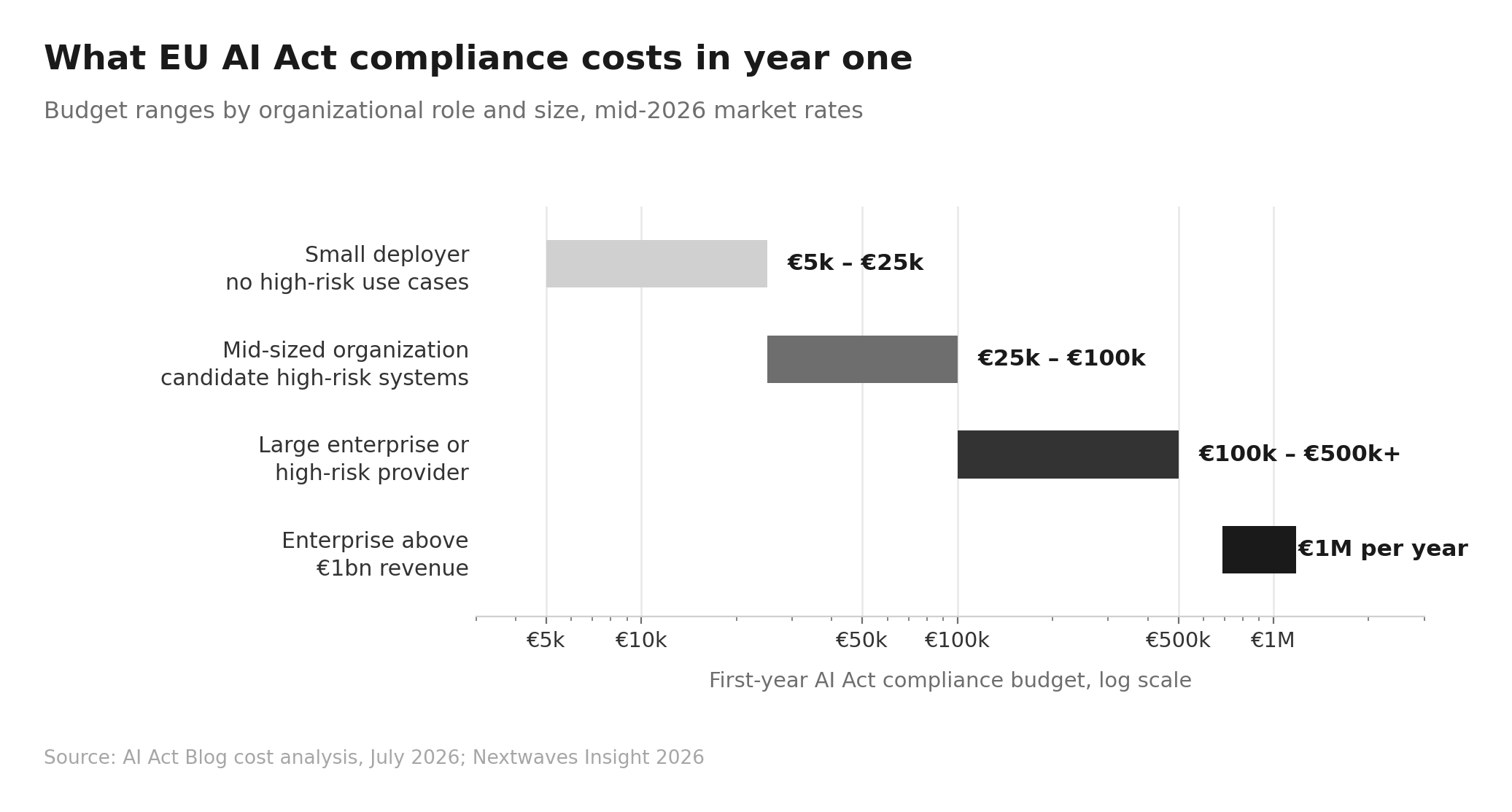
First-year costs scale with role and size.
- A small deployer with no high-risk use cases should expect €5,000 to €25,000.
- A mid-sized organization with candidate high-risk systems should budget €25,000 to €100,000.
- A large enterprise, or any organization placing high-risk AI on the market, reaches €100,000 to €500,000 or more once conformity work, AI compliance audit cycles, and ongoing governance are included (source: AI Act Blog).
- Enterprises above €1 billion in revenue may spend around $1 million a year on AI Act programs alone.
Training adds €1,000 to €5,000 per employee, and companies with mature governance spend roughly 30% less on external advisory (source: SQ Magazine).
The Talent Market the Act Created
Someone has to own conformity, and that demand is visible in pay. A Chief AI Ethics Officer or Governance Lead commands €150,000 to €250,000 in Europe.
Elsewhere, AI Compliance Managers earn $125,000 to $200,000, AI Auditors $130,000 to $188,000, and Responsible AI Scientists $180,000 to $221,000 (source: TechJack Solutions).
One IAPP certification correlates with 13% higher pay, multiple certifications with 27%, and professionals bridging privacy and AI governance earn a US median of $169,700 against $151,800 for AI-only practitioners (source: VerifyWise).
Supply is the constraint. AI Compliance Officer postings rose roughly 45% year over year, and 98.5% of organizations report they cannot find enough qualified candidates (source: Archuz).
Those that cannot hire are staffing hybrid roles from existing legal, privacy, and risk teams.
Penalties and Who Enforces Them
Penalty tiers are turnover-linked and take whichever figure is higher.
| Violation | Maximum penalty |
|---|---|
| Prohibited practices (Article 5) | €35M or 7% of global annual turnover |
| Most other obligations, including high-risk and transparency | €15M or 3% of global annual turnover |
| Supplying incorrect or misleading information to authorities | €7.5M or 1% of global annual turnover |
| GPAI model providers (Commission-imposed) | €15M or 3% of global annual turnover |
Enforcement is split. GPAI model providers answer to the Commission's AI Office exclusively.
Everyone else answers to the national market surveillance authority where the system is placed on the market, and designation has been uneven across the 27 Member States, so identical conduct may draw an inspection in one and nothing in another.
The reach is extraterritorial, like GDPR: any provider or deployer whose AI output is used in the EU is in scope.
A Practical 12-Month Roadmap
- Months 1 to 2: Build the AI system inventory. List every AI system in production, including features embedded in tools you bought as something else. Cheapest phase, and everything depends on it.
- Months 2 to 3: Run AI risk classification. Sort each system into prohibited, high-risk, limited-risk, or minimal-risk. Flag every case where you might be the provider rather than the deployer.
- Month 3: Close the Article 50 gap. Disclosure on customer-facing systems, machine-readable marking on synthetic output. For legacy generative systems, 2 December 2026 is the binding date.
- Months 4 to 6: Assign ownership and build documentation. Name a governance owner and stand up a technical documentation template. This is where 74% of organizations are still stuck.
- Months 6 to 9: Rewrite AI incident reporting for three clocks. 24 hours, 72 hours, 15 days, three authorities.
- Months 9 to 12: Start the high-risk track and schedule your first AI compliance audit. Conformity assessment for one system routinely runs past twelve months once a third party is involved. Use the deferral as runway, not a pause.
An AI governance framework for mid-market regulated industries and sector-specific AI governance checklists beat drafting from the regulation text.

Conclusion
Growth Centr gives operators the regulatory picture their vendors will not hand them.
The EU AI Act moved from paper to enforcement on 2 August 2026: Article 50 duties now bind providers and deployers, the AI Office can fine general-purpose model providers up to 3% of global turnover, and the full penalty regime is live.
The Digital Omnibus deferred the high-risk obligations to 2 December 2027 for standalone Annex III systems and 2 August 2028 for AI embedded in regulated products, but it changed the deadline, not the requirements.
AI risk management, data governance, technical documentation, post-market monitoring, human oversight requirements, and AI model security still arrive in full.
With 78% of enterprises unprepared and recurring costs near €29,277 per high-risk system, organizations that spend the next sixteen months on inventory, AI risk classification, and documentation will absorb this as a line item.
Those treating the deferral as a reprieve will absorb it as a crisis.
Read Next
- What Is Conversion Rate Optimization (CRO)?
- Cybersecurity Stack Requirements for SOC 2, HIPAA, and ISO 27001 Compliance
- Marketing ROI Statistics
FAQs
1. What is the EU AI Act deadline for high-risk AI systems in 2026?
The EU AI Act deadline for high-risk AI systems is no longer in 2026. Under Regulation (EU) 2026/1744, standalone Annex III systems must comply by 2 December 2027 and AI embedded in Annex I regulated products by 2 August 2028. The original 2 August 2026 date was deferred six days before it would have applied.
2. How does the EU AI Act change AI protection requirements for enterprises?
The EU AI Act changes AI protection requirements for enterprises by making risk management, data governance, technical documentation, automatic logging, human oversight, and cybersecurity resistance legally mandatory for high-risk systems, and by imposing immediate transparency duties on any system that interacts with people or generates synthetic content.
3. What are the maximum fines under the EU AI Act?
The maximum fines under the EU AI Act are €35 million or 7% of global annual turnover, whichever is higher, for prohibited practices under Article 5. Most other violations carry up to €15 million or 3% of turnover, and supplying misleading information to authorities carries up to €7.5 million or 1%.
4. Does the EU AI Act apply to companies outside the EU?
The EU AI Act applies to companies outside the EU whenever their AI system's output is used within the Union. The reach is extraterritorial like GDPR, so a US or UK provider serving European customers is in scope regardless of where it is headquartered.
5. How much does EU AI Act compliance cost an enterprise?
EU AI Act compliance costs an enterprise roughly €29,277 per high-risk system annually, with first-year program costs of €25,000 to €100,000 for mid-sized organizations and €100,000 to €500,000 or more for large enterprises or providers placing high-risk AI on the market.
Disclaimer: This content is provided for informational purposes only and does not constitute legal, financial, or compliance advice. Protocol versions, governance arrangements, and partner counts cited here reflect publicly announced milestones as of August 2026 and are moving quickly. Adoption figures come from vendor and foundation announcements with differing methodologies and should be treated as directional signals rather than guaranteed outcomes.