
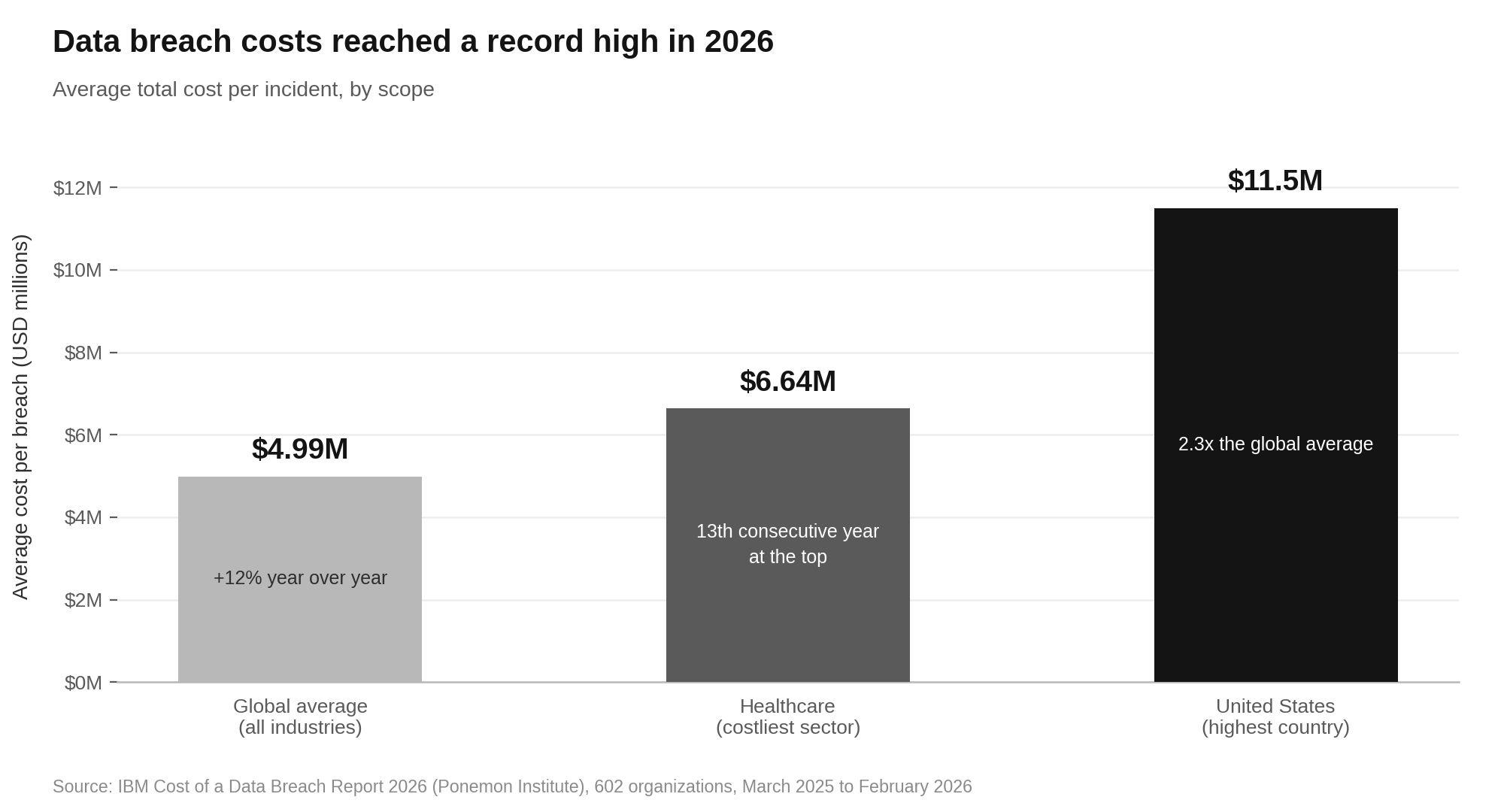
The global average cost of a data breach climbed 12% to $4.99 million in 2026, the highest figure in the 21 years the study has been running, with US organizations averaging $11.5 million per incident (source: HIPAA Journal).
GrowthCentr helps B2B and SaaS operators turn regulatory complexity into stack decisions that survive both an auditor's testing period and an enterprise buyer's security review.
Most companies pursue SOC 2, HIPAA, and ISO 27001 because a deal stalled at procurement, a health system asked for a Business Associate Agreement, or a European customer wanted a certificate number.
The trap is buying tools one framework at a time, then rebuilding the same controls twice.
This guide breaks down which tooling each framework requires, where the three overlap, what the stack costs in 2026, who you need to hire, and the sequence that gets you audit-ready fastest.
Key Takeaways
- One control set can satisfy roughly 70% of SOC 2, HIPAA, and ISO 27001 requirements.
- Identity and access management, logging, encryption, and vendor risk get tested first.
- First-year SOC 2 costs run $30,000 to $150,000 including tooling, readiness, and audit fees.
- Third parties were involved in 48% of 2025 breaches, up 60% year over year.
- GRC managers average $160,304 in 2026, and automation cuts audit prep 60% to 80%.
The 2026 Compliance Landscape in Numbers
Security budgets are expanding faster than most technology lines.
Gartner's 2Q26 forecast puts worldwide information security spending at $248.9 billion in 2026, up 12.7% in constant currency and reaching $372.6 billion by 2030 (source: Software Strategies Blog).
The threat data explains why. Verizon's 2026 Data Breach Investigations Report found vulnerability exploitation became the leading initial access vector at 31% of breaches, overtaking credential abuse for the first time, while ransomware appeared in 48% of confirmed breaches (source: SecurityWeek).
Credential abuse still appears in 39% of breach chains, and the human element featured in 62% (source: Abnormal AI).
Detection remains the bottleneck. Mean time to identify and contain a breach rose to 247 days in 2026, and AI-driven attacks increased 56% year over year, adding roughly $1 million to malicious breach costs (source: Becker's Hospital Review).
That is the practical argument for the monitoring layer described below.
Why Buyers, Not Regulators, Set the Deadline
Certification volume tells the demand story better than any market forecast.
The ISO Survey recorded 96,709 valid ISO/IEC 27001 certificates covering 179,877 sites worldwide, up from 36,362 five years earlier, and since 31 October 2025 every valid certificate sits on the 2022 revision with its 93 Annex A controls (source: ComplianceDocs).
SOC 2 has followed a parallel path in North America, functioning as a procurement gate rather than a legal obligation.
Enterprise questionnaires now routinely require an attestation report before a contract moves forward, which is why most first audits begin with a stalled deal rather than a compliance calendar.
If you are still assembling foundational tooling, this guide to building a cybersecurity stack covers the baseline all three frameworks assume you have.
HIPAA is the outlier: regulators enforce it, not customers.
The HHS Office for Civil Rights resolved six investigations with financial penalties and collected $1,278,000 in the first half of 2026, identifying risk analysis failures in each of the four ransomware settlements (source: HIPAA Journal).
Penalty tiers run from $141 to $72,596 per violation, capped near $2.19 million annually for repeat violations of the same requirement (source: Virtual Sprout).
What Each Framework Actually Requires
The three ask similar questions in different dialects:
- SOC 2 is a principle-based attestation against Trust Services Criteria.
- ISO 27001 certifies a management system, so process documentation carries as much weight as tooling.
- HIPAA is prescriptive law with technical safeguards written in 2003 and now being modernized.
| Dimension | SOC 2 | HIPAA | ISO 27001:2022 |
|---|---|---|---|
| Type | CPA attestation report | Federal regulation | Accredited certification |
| Output | Type 1 or Type 2 report | No certificate; enforcement only | 3-year certificate, annual surveillance |
| Control basis | 5 Trust Services Criteria | Administrative, physical, technical safeguards | 93 Annex A controls, clauses 4 to 10 |
| Scope driver | Systems supporting the service commitment | Any system touching ePHI | Whatever the ISMS scope statement defines |
| Mandatory risk assessment | Yes (CC3) | Yes (§164.308(a)(1)) | Yes (clause 6.1) |
| Evidence period | 3 to 12 months for Type 2 | Continuous | Continuous, sampled at audit |
| Typical timeline | 4 to 9 months | Ongoing | 6 to 12 months |
The proposed HIPAA Security Rule update would close most of that gap, converting previously "addressable" specifications into mandates:
- Encryption of ePHI at rest and in transit
- Multi-factor authentication for all systems accessing ePHI
- Asset inventories
- Annual penetration testing
- Vulnerability scanning every six months
- 72-hour incident reporting.
As of mid-2026, the rule remains proposed, with agenda dates slipping repeatedly, and HHS estimates first-year compliance costs across regulated entities at roughly $9 billion (source: BD Emerson).
Build to the proposed standard now, because SOC 2 and ISO 27001 auditors already expect those controls.
The Nine Layers of a Compliant Security Stack
1. Identity and Access Management
Identity and Access Management (IAM) is where auditors start, and where the DBIR root-cause analysis consistently lands.
You need single sign-on, phishing-resistant Multi-Factor Authentication (MFA) on every account including service accounts, role-based access control mapped to job functions, automated provisioning and deprovisioning tied to your HR system, and quarterly access reviews with retained evidence.
A business password manager covers credentials SSO cannot reach, such as shared vendor logins and legacy systems.
2. Endpoint Security and Device Management
Unified endpoint management enrolling every company device, full-disk encryption verified centrally, Endpoint Detection and Response (EDR), plus screen-lock and patch policies enforced by configuration rather than by written policy.
Bring-your-own-device arrangements need containerization or an explicit documented exclusion.
Distributed teams add complexity, and remote work technology decisions carry direct audit consequences.
3. Network and Infrastructure Security
Segmentation between production and corporate networks, a zero trust architecture governing administrative paths (or at minimum a business VPN), firewall rules under version control, and perimeter intrusion detection.
Cloud workloads add Cloud Security Posture Management (CSPM) to catch misconfigured storage, over-permissive IAM roles, and drift between infrastructure code and running state. It is the fastest-growing security subsegment at 27.6% CAGR through 2030, because auditors now want configuration evidence, not architecture diagrams.
The proposed HIPAA rule names segmentation explicitly, and ISO 27001 A.8.22 has required it since 2022.
4. Data Protection and Encryption
AES-256 at rest, TLS 1.2 or higher in transit, encryption key management handled by a dedicated KMS with documented rotation and separation of duties, data classification applied to storage locations, and Data Loss Prevention (DLP) on egress paths.
Retention and disposal schedules must be documented and demonstrably executed. Teams handling model training data should review the mechanics of data privacy in AI systems before scoping.
5. Logging, Monitoring, and Detection
Centralized log aggregation with tamper-evident storage, Security Information and Event Management (SIEM) or an equivalent correlation layer, alerting with defined severity tiers and on-call routing, and one year of log retention as the practical floor.
RMM tool abuse by threat actors rose 240% year over year while traditional command-and-control malware fell 27% (source: Push Security), so detection content must now cover legitimate administrative tooling, not just known-bad binaries.
6. Vulnerability Management and Patching
With exploitation now the leading breach vector, vulnerability management is the layer with the shortest defensible response window.
It requires authenticated scanning on a defined cadence, an asset inventory that scanners actually reach, container and dependency scanning in the build pipeline, and remediation SLAs by severity that you can prove you met.
Annual penetration testing is not strictly required by SOC 2 but is demanded by nearly every enterprise buyer and named in the proposed HIPAA rule.
Embedding these checks upstream is the core of DevSecOps.
7. Backup, Recovery, and Business Continuity
Automated encrypted backups with at least one immutable or offline copy, documented recovery time and recovery point objectives, and restoration testing evidenced annually.
HIPAA makes contingency planning a required standard, and the proposed update adds restoration timeframes.
8. Third-Party Risk Management
With third parties involved in 48% of breaches, Third-Party Risk Management (TPRM) has moved from a checklist item to a primary control.
You need a maintained vendor inventory, tiered risk assessments, signed BAAs for every vendor touching ePHI, review of subservice organization reports, and offboarding procedures that actually revoke tokens.
OAuth scope and token rotation deserve specific attention after the vendor-application campaigns of the past year.
The vendor consolidation trade-off applies: fewer vendors means fewer assessments, but a concentrated blast radius.
9. GRC and Compliance Automation
Policy management with version control and attestation tracking, a risk register mapping risks to controls to evidence, security awareness training with completion records, and continuous control monitoring.
The compliance automation category exceeded $15.9 billion in 2026 at a 15.2% CAGR, with 71% of organizations adopting some form of regulatory automation (source: Orbiq).
These platforms cut audit preparation by 60% to 80%, though they do not reduce the auditor's fee.
An underrated risk here is tooling nobody sanctioned.
Shadow AI and unsanctioned tools create data flows that never appear in your scope documentation, exactly the kind of finding that turns a clean report into a qualified one.
The Control Overlap Map
The efficiency argument for building once is strongest in the middle of the stack.
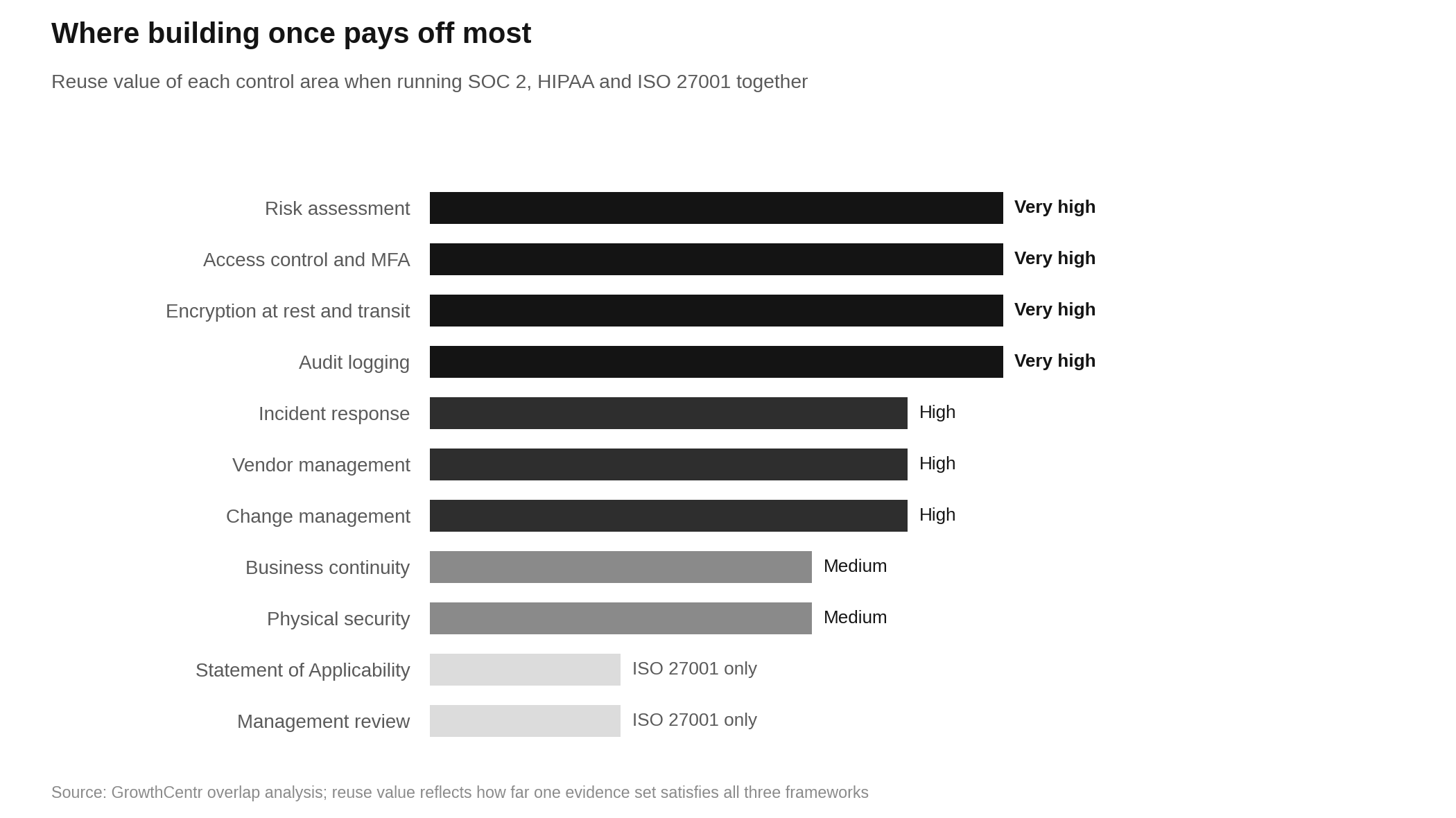
The reusable core is the risk assessment, the asset inventory, and the evidence pipeline. Build those three once in a form all frameworks accept, and the incremental cost of the second and third drops sharply.
What the Stack Costs in 2026
SOC 2 Type 2 compliance in 2026 typically costs $30,000 to $150,000 all in, with smaller SaaS companies spending $30,000 to $50,000 and larger enterprises exceeding $100,000 (source: Bright Defense).
The audit fee alone runs $7,500 to $60,000, and ongoing maintenance settles at roughly $15,000 to $40,000 per year (source: SecureSlate).
| Line item | Seed to Series A | Series B to C | Enterprise |
|---|---|---|---|
| Compliance automation platform | $8K to $15K | $15K to $40K | $40K to $120K |
| Identity provider and MFA | $3K to $8K | $15K to $50K | $100K+ |
| EDR and device management | $4K to $10K | $20K to $60K | $150K+ |
| SIEM and log retention | $6K to $18K | $30K to $90K | $200K+ |
| Vulnerability scanning and CSPM | $3K to $9K | $12K to $35K | $60K+ |
| Penetration test (annual) | $8K to $15K | $15K to $40K | $50K+ |
| SOC 2 Type 2 audit fee | $12K to $25K | $25K to $60K | $60K to $150K |
| ISO 27001 certification (3-year) | $15K to $30K | $30K to $70K | $80K+ |
Adding ISO 27001 to an existing SOC 2 program usually adds 25% to 40% incremental effort rather than doubling it, because the technical controls already exist and the extra work concentrates on ISMS documentation, the Statement of Applicability, and management review records.
Staffing and Salary Benchmarks
Tooling does not close a finding; people do. The 2026 US market prices this work as follows.
| Role | 2026 average | Range | Source |
|---|---|---|---|
| Cybersecurity GRC analyst | $99,400 | $79,500 to $137,500 | ZipRecruiter |
| Cybersecurity GRC manager | $132,230 | $99,173 to $241,982 | Glassdoor |
| Governance, risk and compliance manager | $160,304 | $143,077 to $184,525 | Salary.com |
Specialization pays: the cybersecurity-focused GRC average of $99,400 sits well above the general IT GRC average of $70,006 (source: Thinkcloudly).
In Europe, a head of GRC at a regulated scale-up reaches €100,000 to €130,000, and freelance SOC 2 and ISO 27001 consultants bill €600 to €900 daily (source: Bluecoders).
Under roughly 150 employees, the common pattern is one full-time GRC hire plus a fractional virtual CISO and an automation platform.
Above that headcount, security engineering separates from compliance ownership.
A 12-Month Implementation Sequence
- Months 1 to 2: scope and assess. Define system boundaries, build the asset inventory, run the risk assessment. Everything downstream inherits from this, and OCR settlements repeatedly cite its absence.
- Months 3 to 4: identity and endpoints. SSO, MFA everywhere, RBAC, device enrollment, disk encryption. Highest control-per-dollar in the program.
- Months 5 to 6: data and infrastructure. Encryption verification, key management, segmentation, CSPM, backup and restore testing.
- Months 7 to 8: detection and response. Log centralization, alerting, incident response plan, one tabletop exercise with minutes retained.
- Months 9 to 10: policies, training, vendors. Policies published and attested, awareness training completed, vendor inventory tiered. Automating evidence collection with workflow automation tooling prevents a manual scramble later.
- Months 11 to 12: observation window and audit. Run the Type 2 observation period, remediate control drift, engage the auditor. For ISO 27001, insert an internal audit and management review before Stage 1.
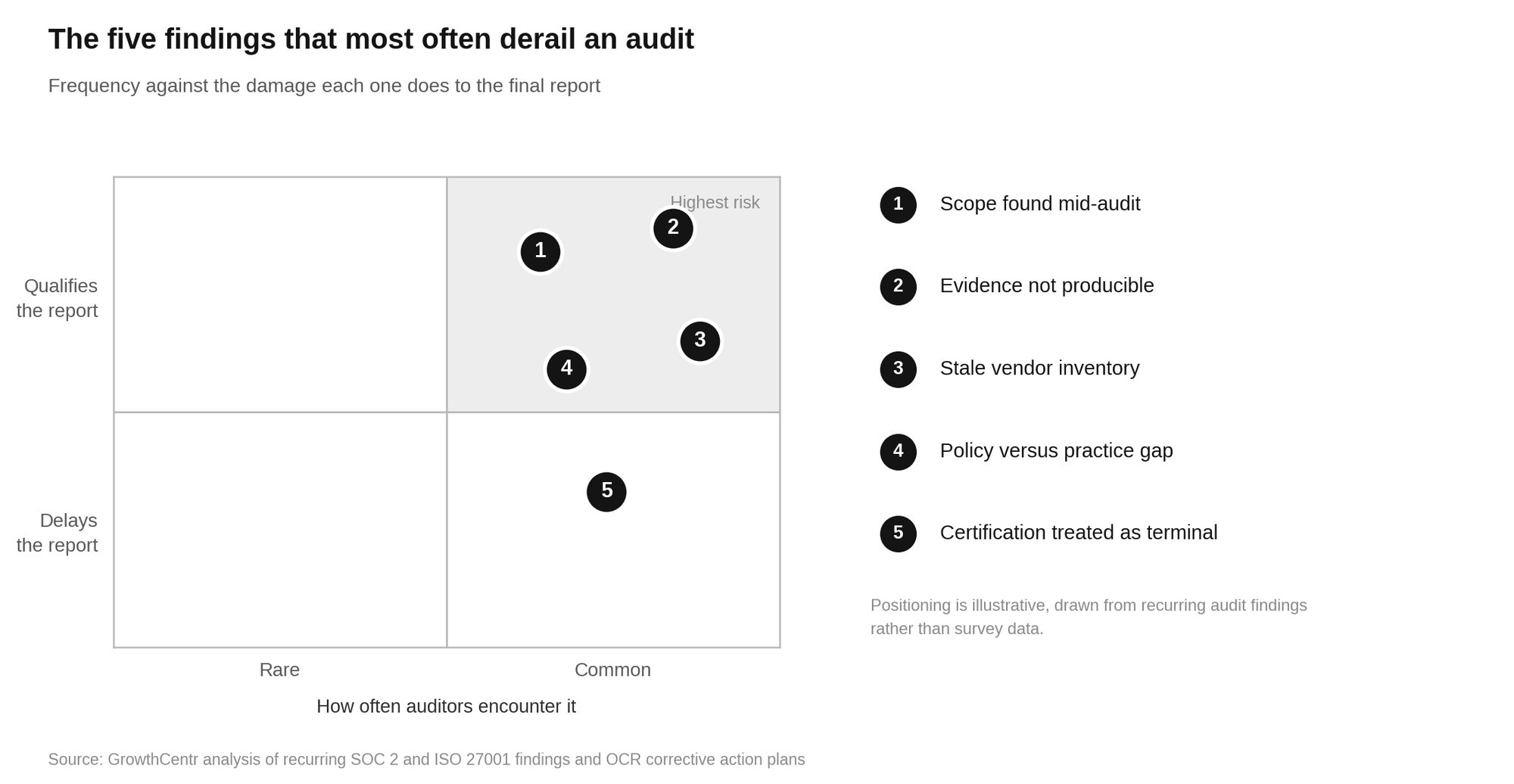
Five Failure Modes That Sink Audits
- Scope discovered mid-audit. A system holding regulated data that never made it into the boundary description forces rescoping and delays the report.
- Evidence that exists but cannot be produced. Access reviews held in a meeting with no artifact are, to an auditor, reviews that did not happen.
- Vendor inventories frozen at onboarding. Contractors keep access, tokens never rotate, subservice reports go unreviewed.
- Policies written for the auditor, not the team. Where documented process differs from observed process, the observed process is the finding.
- Treating certification as terminal. Type 2 reports expire annually and ISO surveillance audits arrive every year. Continuous monitoring is what makes year two cheaper, as this strategic guide to the modern cybersecurity stack explains.
Conclusion
GrowthCentr exists to help operators make infrastructure decisions that hold up under scrutiny, whether that scrutiny comes from an auditor, a regulator, or a procurement team with a 120-question spreadsheet.
SOC 2, HIPAA, and ISO 27001 look like three separate projects, but at the tooling layer they are largely one: identity and access management, multi-factor authentication, endpoint detection and response, zero trust architecture, cloud security posture management, encryption key management, data loss prevention, SIEM-based monitoring, vulnerability management, and third-party risk management, all feeding a GRC layer that turns activity into producible evidence.
The frameworks diverge in paperwork, scoping logic, and enforcement, but the underlying stack is shared.
Companies that build to the union of the three once, sequence from risk assessment outward, and invest in continuous monitoring rather than annual fire drills spend materially less than those bolting on each framework as a new deal demands it.
Read Next
FAQs
1. What is the best cybersecurity stack for SOC 2, HIPAA, and ISO 27001 compliance in 2026?
The best cybersecurity stack for SOC 2, HIPAA, and ISO 27001 compliance in 2026 combines identity and access management with multi-factor authentication, endpoint detection and response, zero trust architecture for administrative access, cloud security posture management, encryption key management, data loss prevention, a SIEM for centralized monitoring, vulnerability management, immutable backups, third-party risk management, and a compliance automation platform that maps evidence to all three frameworks at once.
2. How much does it cost to comply with SOC 2, HIPAA, and ISO 27001 together?
Complying with SOC 2, HIPAA, and ISO 27001 together typically costs $60,000 to $250,000 in the first year for a mid-market company, since SOC 2 alone runs $30,000 to $150,000 and ISO 27001 adds roughly 25% to 40% incremental effort once the technical controls exist. HIPAA carries no certification fee but adds BAA management, risk analysis documentation, and breach notification readiness.
3. Which controls overlap across SOC 2, HIPAA, and ISO 27001?
The controls that overlap across SOC 2, HIPAA, and ISO 27001 are risk assessment, identity and access management with multi-factor authentication, encryption key management, audit logging, incident response, change management, third-party risk management, and business continuity. These represent roughly 70% of the total control surface, which is why a single evidence pipeline beats three parallel programs.
4. Do I need a SIEM to pass a SOC 2 audit?
You do not strictly need a SIEM to pass a SOC 2 audit, but you do need centralized, tamper-evident log collection with alerting and documented review, which most teams find easier to satisfy with Security Information and Event Management tooling than with manual review. ISO 27001 A.8.15 and A.8.16 and HIPAA §164.312(b) impose similar expectations, so the investment is reusable.
5. How long does it take to become compliant with all three frameworks?
Becoming compliant with all three frameworks typically takes 9 to 18 months from a standing start: roughly 4 to 9 months to a SOC 2 Type 2 report including the observation window, 6 to 12 months to ISO 27001 certification including internal audit and management review, and HIPAA readiness in parallel once risk analysis, encryption, MFA, and the BAA program are in place.
Disclaimer: This content is provided for informational purposes only and does not constitute legal, financial, or compliance advice. Protocol versions, governance arrangements, and partner counts cited here reflect publicly announced milestones as of August 2026 and are moving quickly. Adoption figures come from vendor and foundation announcements with differing methodologies and should be treated as directional signals rather than guaranteed outcomes.