
In June 2026, the ChatGPT app crossed 1 billion monthly active users, becoming the fastest app in history to reach that scale, according to Sensor Tower estimates reported by Reuters (Source: Panto).
GrowthCentr helps B2B SaaS and ecommerce teams turn shifts like this into pipeline by building visibility inside AI assistants, agentic commerce channels, and the search surfaces that now sit upstream of every buying decision.
ChatGPT is no longer a single product metric to watch. It is a distribution channel, an enterprise software line item, a labour market signal, and a growing referral source for anyone selling online.
This article breaks down the most important verified ChatGPT statistics for 2026 across users, traffic, demographics, revenue, enterprise adoption, market share, commerce, and salaries, with the context you need to act on each one.
Key Takeaways
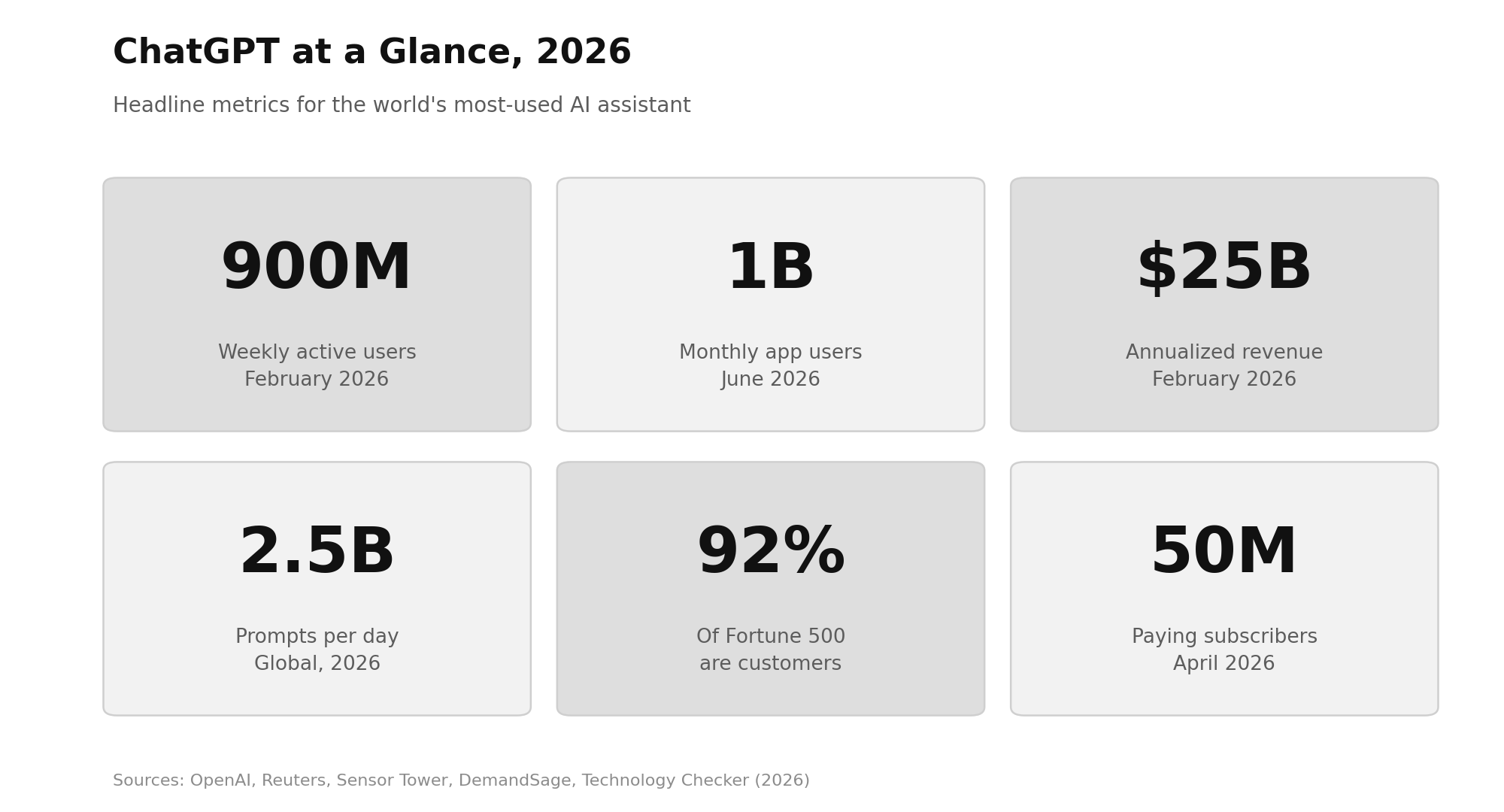
- ChatGPT reached 900 million weekly active users in February 2026, doubling year over year.
- OpenAI crossed $25 billion annualized revenue by February 2026, roughly $2 billion monthly.
- 92% of Fortune 500 companies use ChatGPT across 7 million workplace seats.
- ChatGPT drives roughly 92% of all measurable AI referral traffic to websites.
- AI-referred visitors converted 42% better than non-AI traffic in March 2026.
The AI Assistant Market in 2026
Generative AI moved from pilot to production budget line inside a single planning cycle. Gartner forecasted that more than 80% of enterprises will have deployed GenAI applications in production by the end of 2026, and McKinsey's State of AI survey found that 88% of organizations now use AI in at least one business function (Source: Link Publishers).
Spend is following adoption. In the US, business AI adoption crossed the 50% line for the first time in March 2026, reaching 50.4% of businesses paying for some kind of AI service, with OpenAI present in 35.2% of US businesses (Source: Thunderbit).
Company size still dictates depth: in the EU, 17% of small, 30% of medium, and 55% of large enterprises used AI in 2025, and globally nearly half of companies above $5 billion in revenue are scaling AI versus 29% of those under $100 million (Source: Thunderbit).
Where ChatGPT Sits Against Competitors
ChatGPT still owns the category, but the margin is narrowing. ChatGPT held 80.49% of the worldwide AI chatbot market in January 2026, ahead of Perplexity at 7.89% and Gemini at 7.18% (Source: Digital Elevator).
Broader assistant measures tell a tighter story: across the global AI assistant market, ChatGPT holds 46.4%, with Gemini at 27.7% and Claude at 10.3% (Source: Superlines).
Google's Gemini app reached 750 million monthly users by the end of the December quarter, still behind ChatGPT but closing the gap (Source: Panto).
On the enterprise side the pressure is real: OpenAI's enterprise LLM market share fell from 50% in 2023 to approximately 27% in late 2025 as Anthropic grew to 40% enterprise share (Source: AI Business Weekly).
One data point frames the competitive reality for marketers. 95% of ChatGPT's web users also use Google, meaning generative AI has added a layer to search rather than replacing it (Source: Mango Thrive).
If you are mapping where your brand appears across both layers, our guide to AI search visibility for B2B SaaS covers the measurement setup.
ChatGPT User Statistics
| Milestone | Users | Date |
|---|---|---|
| 100M monthly active users | 100M MAU | January 2023 |
| 200M weekly active users | 200M WAU | August 2024 |
| 400M weekly active users | 400M WAU | February 2025 |
| 800M weekly active users | 800M WAU | October 2025 |
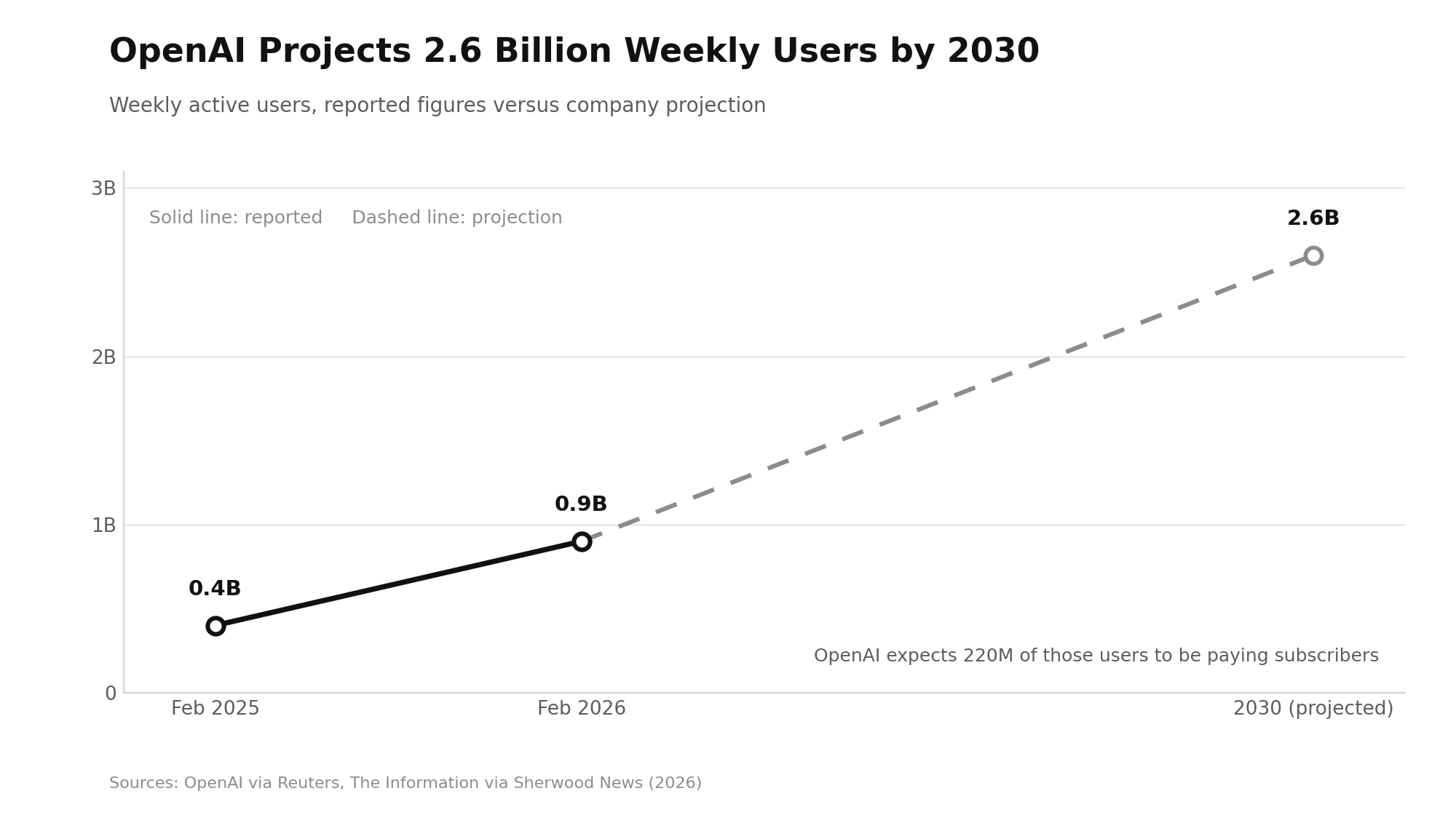
| 900M weekly active users | 900M WAU | February 2026 |
| 1B monthly app users | 1B MAU | June 2026 |
(Source: Backlinko)
ChatGPT reached 900 million weekly active users in February 2026, more than doubling its 400 million weekly user base from exactly one year earlier (Source: Omnibound).
By late July 2026, The Information reported weekly actives were nearing 1 billion, though OpenAI has not officially confirmed that threshold (Source: Panto).
The speed remains the outlier. It took Instagram 2.5 years to reach 100 million users and ChatGPT did it in 2 months, while Facebook needed 4 years to reach 500 million (Source: Omnibound).
This represents a nine-fold increase in weekly active users since November 2023, when ChatGPT reported 100 million weekly users (Source: NerdyNav).
ChatGPT Traffic and Engagement Statistics
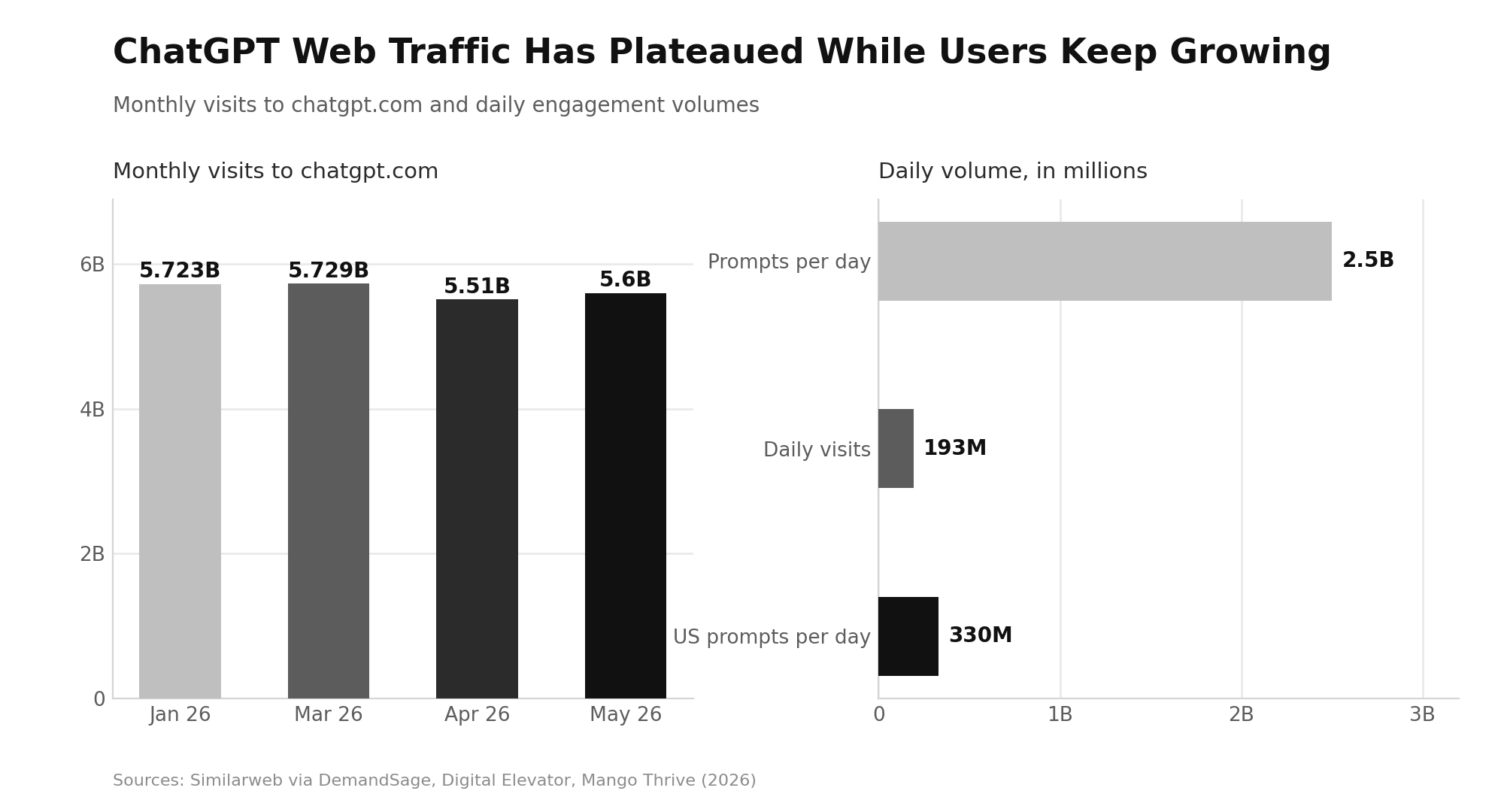
- ChatGPT.com is the fifth most-visited website in the world, with roughly 5.6 billion visits in May 2026 (Source: Mango Thrive).
- ChatGPT recorded more than 5.51 billion monthly visits in April 2026, a 3.84% decline from about 5.729 billion the prior month (Source: DemandSage).
- ChatGPT gets 193.33 million visits per day, roughly 134,259 visits per minute (Source: DemandSage).
- ChatGPT receives about 2.5 billion prompts per day globally, roughly 330 million of them from the US (Source: Digital Elevator).
- Users were sending 18 billion messages a week as of July 2025 (Source: Panto).
- There have been 1.44 billion ChatGPT app downloads so far (Source: DemandSage).
- ChatGPT answers average 1,686 characters per response versus 997 for Google (Source: Superlines).
Note the divergence between visits and users. Monthly visit counts have gone flat to slightly negative in 2026 while active user counts keep climbing, which suggests deeper habit among existing users rather than a traffic collapse.
ChatGPT Demographics Statistics
The user base has normalised toward the general population. According to the SimilarWeb panel, ChatGPT's audience is 53.08% male and 46.92% female, a significant shift from the roughly 66/34 split reported in early 2024 (Source: Elfsight).
About 80% of ChatGPT's earliest active users had typically masculine first names, and by March 2026 users with typically feminine names accounted for 53.5% of all messages (Source: Mango Thrive).
Age skews young but is broadening:
| Age group | Share of messages (March 2026) |
|---|---|
| 18-24 | 30.3% |
| 25-34 | 35.8% |
| 35-44 | 18.6% |
| 45-54 | 9.1% |
| 55-64 | 3.7% |
| 65+ | 2.4% |
(Source: Mango Thrive)
US survey data broadly agrees: 61% of adults 18-29 and 55% of 30-49 use ChatGPT, versus 37% of 50-64 and 19% of 65+, per Pew in February 2026, and Pew's Americans and AI 2026 report found 44% of US adults use ChatGPT (Source: GPT Insights). The share of users over 35 is growing fastest recently (Source: GPT Insights).
How People Actually Use ChatGPT
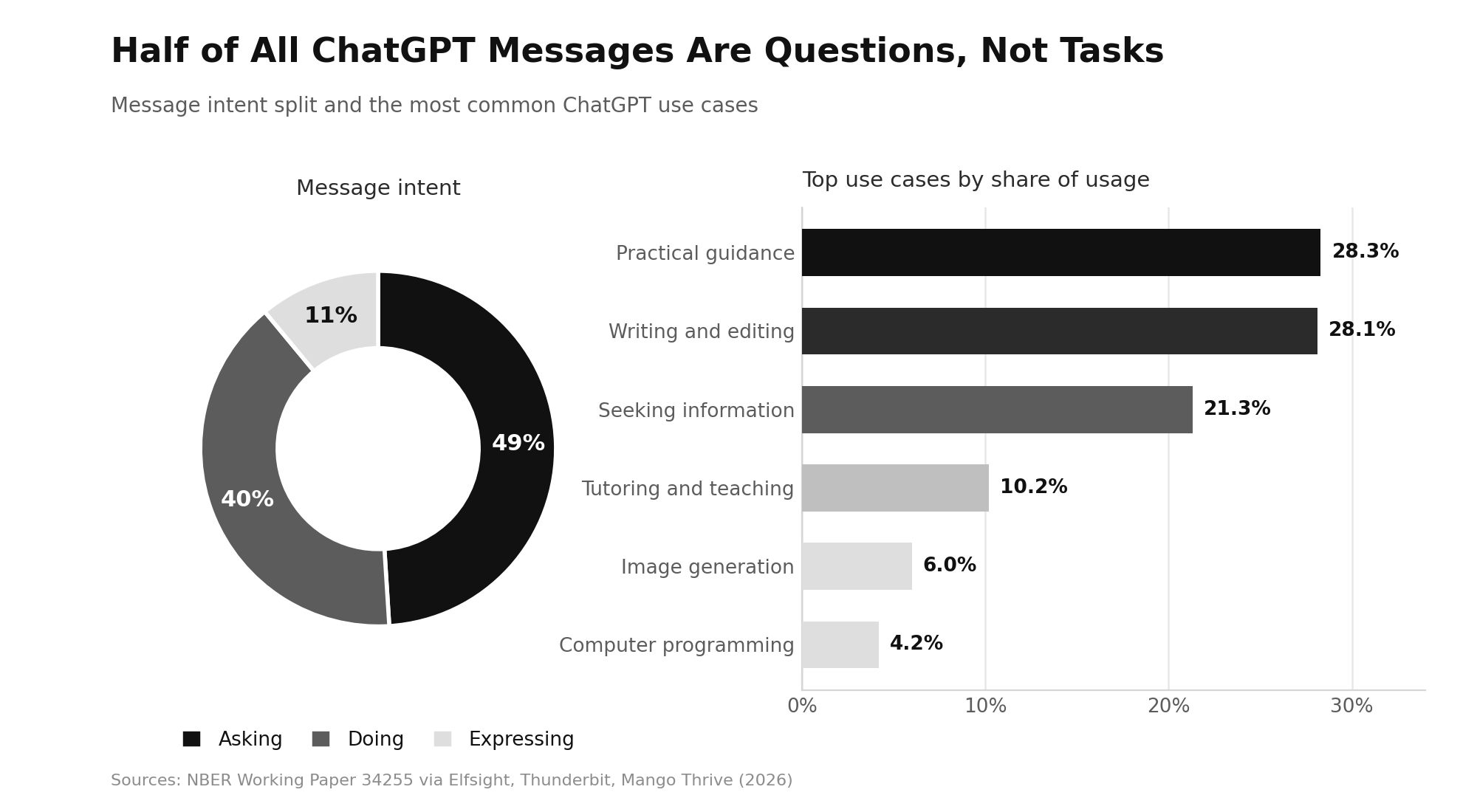
The OpenAI-commissioned NBER working paper remains the best behavioural dataset available. It found that 49% of ChatGPT messages are classified as "Asking" (information retrieval and guidance), 40% as "Doing" (writing, coding, analysis), and 11% as "Expressing" (creative and conversational use) (Source: Elfsight).
- The most common uses are practical guidance (28.3%), writing and editing (28.1%), and seeking information (21.3%) (Source: Thunderbit).
- 73% of consumer usage is non-work-related (Source: Elfsight).
- Only 4.2% of ChatGPT messages are about computer programming, far less than the 10.2% that are tutoring and teaching requests (Source: Mango Thrive).
- More than 5% of messages are health-related, per OpenAI's January 2026 report (Source: GPT Insights).
- Image generation and analysis now account for over 6% of usage (Source: Thunderbit).
The takeaway for content teams: the dominant behaviour is question-answering, not creation. That is why structured, extractable answers now outperform long narrative pages in AI surfaces.
ChatGPT Revenue and Monetization Statistics
- OpenAI's annualized revenue climbed from $10 billion in June 2025 to more than $25 billion by February 2026, in under 9 months (Source: Omnibound).
- Q1 2026 alone was $5.7 billion, putting the full-year target at $30 billion (Source: AI Business Weekly).
- OpenAI confirmed 50 million paying subscribers across all tiers in its April 2026 announcement (Source: Technology Checker).
- ChatGPT Plus contributes $2.4 billion, with Team, Enterprise, and API usage fees accounting for the remaining $22 to $23 billion (Source: Second Talent).
- More than 40% of OpenAI's revenue now comes from business and enterprise customers, and March 2026 data shows $275 million in mobile revenue from US users in a single month (Source: Link Publishers).
- OpenAI closed a funding round in March 2026 with $122 billion in committed capital at an $852 billion post-money valuation (Source: Second Talent).
- OpenAI is targeting $125 billion in annual revenue by 2029 (Source: Sitebard).
- OpenAI's ads pilot reached $100 million in ARR in under six weeks (Source: FATJOE).
ChatGPT Enterprise and Business Adoption Statistics
92% of Fortune 500 companies use ChatGPT, and more than 7 million enterprise workplace seats are active, up 9x year over year (Source: Omnibound).
OpenAI reports 1 million-plus business customers as of November 2025 and 9 million-plus paying business seats by 2026 (Source: Link Publishers).
That 9 million figure grew 4x in under six months (Source: Second Talent). Omnibound + 2
Developer traction is a second adoption layer. OpenAI's developer ecosystem has grown to 4 million developers, with its API processing 15 billion tokens per minute (Source: Panto).
There are 3 million active API accounts (Source: Technology Checker). Codex crossed 5 million weekly users in June 2026, up from 2 million in April (Source: FATJOE).
Stack Overflow's 2025 survey found 81.7% of AI-assistant users relied on ChatGPT, ahead of GitHub Copilot at 67.9% and Google Gemini at 47.4% (Source: Panto).
If you are evaluating deployment models, see our comparison of OpenAI enterprise alternatives and our overview of the Model Context Protocol.
ChatGPT Geographic Statistics
The US leads ChatGPT.com traffic at 18.13%, followed by India at 9.78%, Brazil at 5.68%, Japan at 4.97%, and the UK at 3.18% (Source: NerdyNav).
India became ChatGPT's second-largest market in early 2026, reaching 100 million weekly active users and growing 41% year over year (Source:Omnibound).
ChatGPT maintains an estimated 77.2 million monthly active users in the United States (Source: DemandSage).
Usage grows fastest in lower-income countries, more than 4x faster than in high-income markets (Source: GPT Insights).
ChatGPT is available in 195 countries but banned in 15, including China, Russia, Iran, Cuba, North Korea, and Syria (Source: Index.dev).
ChatGPT Referral Traffic and Conversion Statistics
This is the section that matters most for growth teams, because it is where ChatGPT converts from a usage statistic into a revenue channel.
- ChatGPT accounts for 92.2% of AI referral traffic share, ahead of Gemini at 5% and Perplexity at 1.9%, per Grips Intelligence data via eMarketer (Source: Cognizo).
- AI-driven traffic to US retail sites grew 393% year over year in Q1 2026, and US ecommerce referral visits from ChatGPT grew 210.5% year over year to 20.5 million visits (Source: Cognizo).
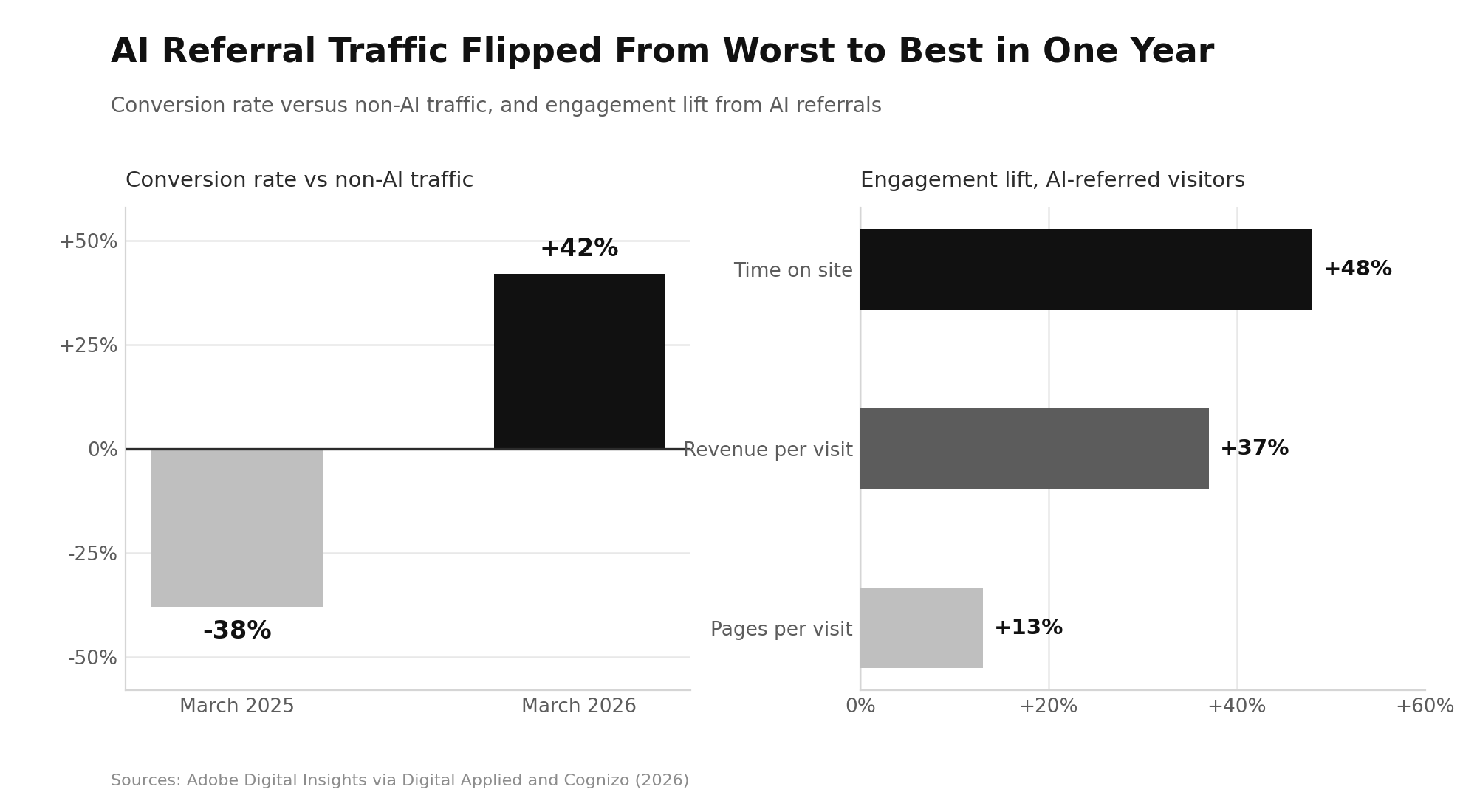
- In March 2026, visitors arriving from AI assistants converted 42% better than non-AI traffic, a reversal from converting 38% worse in March 2025 (Source: Digital Applied).
- AI-referred visitors spent 48% more time on-site, viewed 13% more pages per visit, and generated 37% higher revenue per visit (Source: Cognizo).
- A 12-month GA4 analysis of 94 ecommerce brands found ChatGPT traffic converting at 1.81% versus 1.39% for non-branded organic, with ChatGPT sessions growing 1,079% across 2025 (Source: ALM Corp).
- Only 14% of marketers actually track AI search performance (Source: Authority Tech).
Treat the higher multiples with caution. Seer Interactive notes the critical caveat that these numbers can represent around 1,370 conversions from AI traffic against almost 14 million organic sessions, statistically meaningful but not large in absolute volume (Source: ALM Corp).
The Digital Bloom also estimates that 70.6% of AI traffic may arrive without referrer data (Source: Demand Local), so most dashboards understate the channel.
ChatGPT Commerce Statistics
ChatGPT Search already handles 250 to 500 million queries per week (Source: Link Publishers).
ChatGPT processes an estimated 50 million shopping-related queries per day (Source: Ekamoira).
A Morgan Stanley AlphaWise survey of 2,000 US consumers in November 2025 found 45% had used ChatGPT in the prior month (Source: Paz.ai).
The transaction layer has changed shape. In March 2026 OpenAI deprecated ChatGPT Instant Checkout, shifting the model from buying in the chat to discovering in the chat and transacting on the merchant site (Source: Paz.ai).
Public reporting put merchant adoption at fewer than 15 Shopify stores live before the shutdown (Source: Evolve AMZ).
The 2026 settlement is that AI handles discovery and intent while merchants retain control of checkout, and merchants implementing multiple protocols see roughly 40% more agentic traffic than single-protocol adopters (Source: Elogic).
For the operational detail, see our breakdowns of how to sell on ChatGPT in 2026.
AI Skills, Jobs, and Salary Statistics
ChatGPT fluency now carries measurable wage value. The average wage premium for workers with AI skills in the US rose to 62% in 2026, up from 57% in 2025, according to PwC's Global AI Jobs Barometer (Source: Robert Walters).
The premium reaches 118% in sectors such as consumer markets and 16% in government work, while jobs requiring specific AI skills like prompt engineering grew roughly eight times faster than the overall jobs market, at 69% versus 9% (Source: PwC).
| Role or benchmark | Compensation | Source |
|---|---|---|
| AI engineer US median (Feb 2026) | $173,482 | Pin |
| AI/ML engineer mid-band (Robert Half 2026) | $170,750 | Pin |
| Senior specialists, base pay | $200,000 to $310,000 | Robert Walters |
| OpenAI H-1B base average | $292,115 | Pin |
| Quant and prop trading AI engineers | $210,000 to $450,000 | Let's Data Science |
Specialization rather than job title now drives pay, with LLM fine-tuning and AI safety specialists earning 25% to 45% above generalist ML engineers, while headcount growth at the most AI-exposed companies runs at 52% versus 36% for the least exposed (Source: Robert Walters).
ManpowerGroup's 2026 survey of 39,063 employers found AI skills are the hardest in the world to hire for (Source: Pin).
What These Statistics Mean for Growth Teams
Three conclusions follow:
- First, ChatGPT is now an acquisition channel, not just a productivity tool. With 92% of measurable AI referrals and conversion rates that flipped from negative to positive inside twelve months, the cost of ignoring it compounds.
- Second, attribution is the binding constraint. When 70% of AI traffic arrives without referrer data and only 14% of marketers track the channel, most teams cannot see returns they already earn.
- Third, discovery beats checkout. With Instant Checkout deprecated, the winning play is being cited accurately in the answer, not being purchasable inside the chat.
Statistics to Watch Through 2027
OpenAI projects 2.6 billion weekly users by 2030, with 220 million of them paying (Source: Mango Thrive).
The near-term signals worth tracking are enterprise seat growth against Anthropic's rising share, ads revenue scaling from its $100 million ARR pilot, whether weekly actives officially cross 1 billion, and whether Gemini keeps narrowing the consumer gap.
On the commerce side, watch multi-protocol merchant adoption and whether AI referral conversion premiums hold as volume grows and selection bias thins.
Conclusion
GrowthCentr builds the visibility, content, and measurement infrastructure that lets B2B SaaS and ecommerce teams capture demand inside AI assistants before their competitors register the channel exists.
The 2026 ChatGPT picture is one of scale meeting monetization: 900 million weekly users and roughly 1 billion monthly app users, $25 billion in annualized revenue, 92% Fortune 500 penetration, 9 million paying business users, and an AI referral channel that now converts better than non-branded organic search.
Market share is slipping at the edges as Gemini and Claude grow, but ChatGPT remains the default surface where buyers ask questions, compare vendors, and form shortlists.
The teams that treat these numbers as a channel plan rather than a trivia sheet will own the next cycle.
Read Next
- What Is an AI House? Definition, Core Systems, and How It Differs from a Smart Home
- 2026 HR Tech Spending Report: How Much Do Companies Spend on HR Per Employee?
- Product Feed Optimization for AI Shopping Agents: What Changed in 2026
FAQs
1. How many people use ChatGPT in 2026?
ChatGPT has more than 900 million weekly active users as of February 2026, and the app crossed 1 billion monthly active users in June 2026. Reporting in late July 2026 suggested weekly actives were approaching 1 billion, though OpenAI has not officially confirmed that figure.
2. What is ChatGPT's market share in 2026?
ChatGPT's market share in 2026 is roughly 77% to 80% of the AI chatbot market and about 46% of the broader AI assistant market, with Gemini at 27.7% and Claude at 10.3%. Its enterprise LLM share is lower, around 27% as of late 2025.
3. How much revenue does ChatGPT generate?
ChatGPT generates revenue as part of OpenAI's more than $25 billion annualized run rate as of February 2026, roughly $2 billion per month. ChatGPT Plus contributes about $2.4 billion, with Team, Enterprise, and API fees making up the rest.
4. What percentage of businesses use ChatGPT?
The percentage of businesses using ChatGPT includes 92% of Fortune 500 companies and 35.2% of US businesses as of March 2026. More than 1 million organizations are paying customers, covering over 9 million paying business users and 7 million workplace seats.
5. Does ChatGPT traffic convert better than Google search traffic?
ChatGPT traffic converts better than non-branded Google organic traffic in most 2026 studies, with AI-referred visitors converting 42% better than non-AI traffic in March 2026 and 31% better than non-branded organic across 94 ecommerce brands. Absolute volumes remain small, so results vary widely by site.
Disclaimer:
This content is provided for informational purposes only and does not constitute legal, financial, or compliance advice. Protocol versions, governance arrangements, and partner counts cited here reflect publicly announced milestones as of August 2026 and are moving quickly. Adoption figures come from vendor and foundation announcements with differing methodologies and should be treated as directional signals rather than guaranteed outcomes.